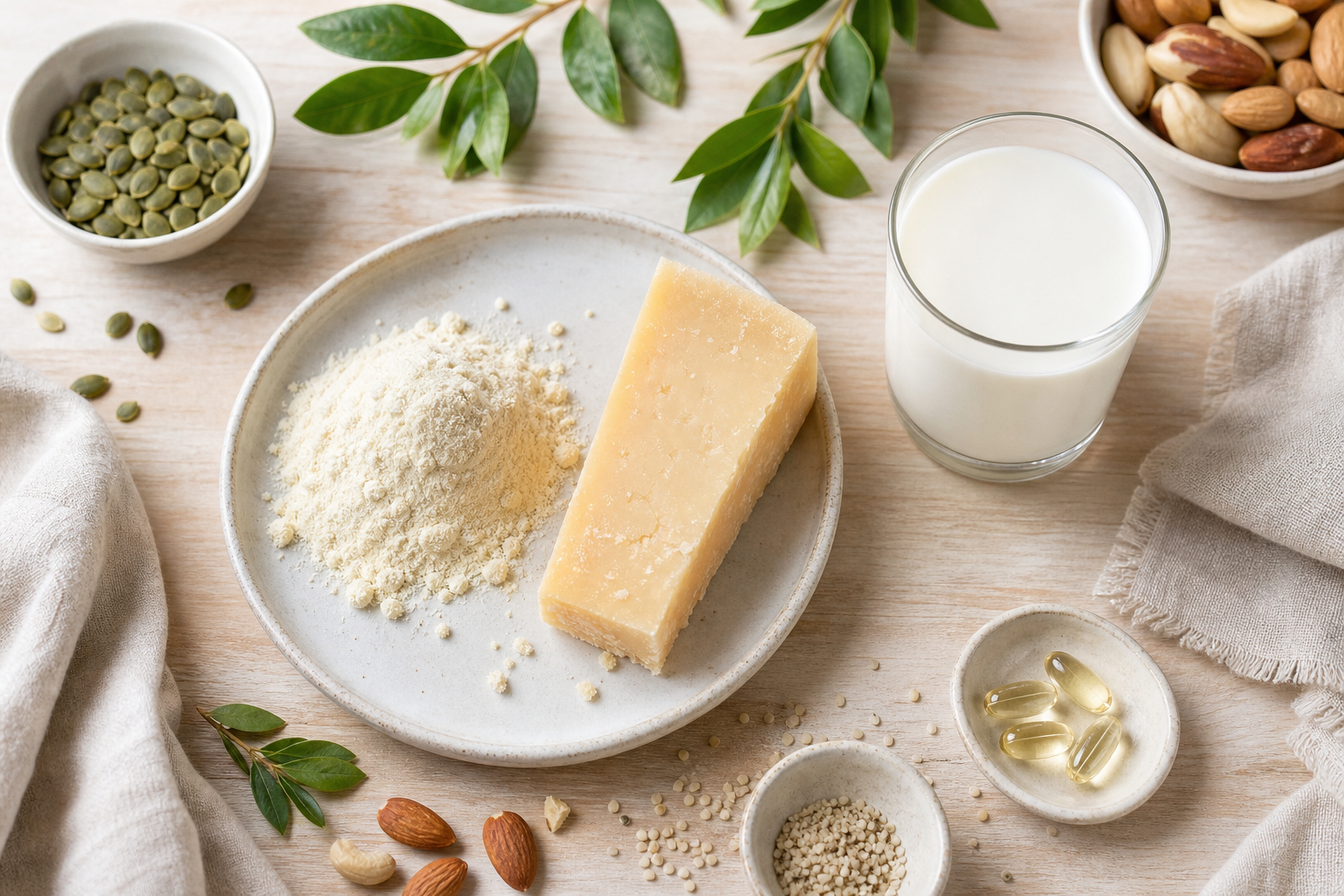
If you are deciding between whey protein isolate (WPI) and whey protein concentrate (WPC), the honest answer is: for most people building daily protein intake, concentrate is the sensible default, and the price premium on isolate buys convenience rather than a better result on muscle or strength. That default stops holding in two checkable situations, which I will name below.
The two are the same compound, from the same source, separated by how far the manufacturer has purified it. That single fact does most of the work in this comparison, and marketing tends to work hard to obscure it.
What are the criteria that actually decide this?
You are choosing on a short list, and the items are not equally weighted. In order of what should move your decision:
- Grams of protein you actually hit per day – the variable with real human-outcome evidence behind it. This is what resistance-training and body-composition trials manipulate.
- Tolerability, mainly lactose – decisive for a minority, irrelevant for everyone else.
- Cost per gram of protein – a genuine criterion, declared here rather than smuggled in.
- Fat and carbohydrate content per serving – matters only at the margins of a tightly controlled diet.
Two criteria you may have arrived with do not matter here, and removing them saves you the most work. Absorption speed: both are fast-digesting whey, and the difference between them is not a lever on muscle growth over days and weeks. Amino acid profile: both deliver the same whey amino acids, including leucine, in closely comparable amounts per gram of protein. Neither is a reason to pay more.
Are isolate and concentrate even the same thing?
This is the section that decides whether a comparison is fair, and it is the one marketing skips. Concentrate and isolate are not two different proteins. They are the same milk-derived whey protein taken to different degrees of purification. Concentrate is filtered to somewhere in a broad 25–90% protein-by-weight range depending on the process used, though most retail concentrate powders land around 70–80%. Isolate is filtered further, to roughly 90% protein or more, with most of the lactose and fat stripped out (Naclerio & Seijo, 2019, citing Hoffman & Falvo 2004 and Etzel 2004 for the processing ranges).
The practical consequence: they share an evidence base. Whey protein supplementation alongside resistance training is linked to gains in muscle mass and strength (Naclerio & Seijo, 2019); when a trial shows that effect, it applies to whey as a protein source. It does not belong exclusively to whichever purity grade happens to be more expensive. A claim that isolate produces a superior training outcome would need a head-to-head human trial comparing the two grades directly at matched protein doses. I have not found one that establishes such a difference, and mechanism alone cannot supply it – a slightly higher protein-per-gram figure is a purity fact, not a demonstrated outcome advantage.
So the real difference is composition per serving, not a different active substance. That reframes the whole choice: you are not buying a better protein, you are buying a cleaner one.
Concentrate: what it is and who it suits
What it is: whey filtered to roughly 70–80% protein, retaining more lactose, fat and the minor whey fractions.
What is shown: whey concentrate carries the bulk of the older whey-supplementation literature. Its evidence for supporting lean mass and strength, in the context of adequate total protein and resistance training, is the same body of evidence usually invoked to sell isolate.
How it genuinely differs: more lactose and a few grams more fat and carbohydrate per serving than isolate.
Who it suits: anyone without meaningful lactose intolerance who wants to raise daily protein intake at the lowest cost per gram.
Cost: consistently the cheaper of the two per gram of protein.
Isolate: what it is and who it suits
What it is: whey filtered further, to around 90% protein, with most lactose and fat removed.
What is shown: the same whey-protein evidence base described above. There is no separate, stronger tier of human outcome data that attaches to isolate specifically.
How it genuinely differs: very low lactose per serving, minimal fat and carbohydrate, and typically a lighter, less creamy texture.
Who it suits: people who react to the lactose in concentrate, and people counting fat and carbohydrate grams tightly enough that a few per serving actually change the day's totals.
Cost: the price premium is real and consistent; the extra purification costs more to produce.
Which differences change an outcome, and which only change comfort?
Sorting the differences honestly:
- Demonstrated and outcome-changing: for someone genuinely lactose intolerant, the lower lactose in isolate changes whether they can use the product comfortably at all. That is a real effect on adherence, which is upstream of every training result.
- Demonstrated but a matter of comfort, price or macros: the lower fat and carbohydrate per serving, and the different mouthfeel. Real, measurable, but not efficacy. They count in isolate's favour only if those specific grams or that texture matter to you.
- Claimed but unverified: that isolate builds more muscle, absorbs "better" in a way that matters, or is a categorically superior protein. These outrun the available comparative human evidence.
The middle bucket is legitimate. If you are in a tight cutting phase and every gram of carbohydrate is accounted for, paying more for isolate is a rational trade – just do not mistake it for buying a better muscle-building result.
Who should choose isolate over concentrate?
Concrete situations, not a vague concession:
- You get digestive symptoms – bloating, cramping, an osmotic laxative effect – from concentrate, and they resolve on a low-lactose isolate.
- You are in a controlled phase where the few extra grams of fat and carbohydrate in concentrate genuinely disrupt your macronutrient targets.
- You strongly prefer the lighter texture and are willing to pay for it – a comfort preference, stated as one.
Outside those, the extra money is not buying you a better training outcome.
A note on how to read health claims like this one
The isolate-versus-concentrate question is a small example of a pattern worth recognising, because the same reasoning applies across supplement marketing. A processing difference that is real and easy to demonstrate – higher protein percentage, lower lactose – gets presented as if it were a demonstrated clinical advantage. The two are different tiers of evidence. This is the same gap that shows up when any product is sold on a mechanism or a purity number rather than on a head-to-head human result.
It is also why a purity fact does not transfer into a performance verdict on its own. A confident head-to-head claim earns its strong language by directly comparing the two options being tested, in the population of interest, on the outcome being sold. That is the standard a genuine "isolate beats concentrate" claim would have to meet, and, on the available whey literature, it has not been met at that level.
Verdict
This one is settled with exceptions. For the majority of people whose goal is simply to reach a daily protein target alongside training, concentrate delivers the same whey protein at a lower cost per gram, and the isolate premium buys convenience – lower lactose, leaner macros, lighter texture – rather than a better physiological result.
Choose isolate when you react to the lactose in concentrate, or when a tightly controlled diet makes the leaner per-serving profile worth paying for. Those are the two conditions you can test on yourself.
The rule to carry to the next product: when a label sells you on a purity number or a processing step, ask whether that specific step was tested head-to-head against the cheaper version in people, measuring an outcome you care about. If it was not, you are paying for chemistry that is real and an advantage that is unproven.
Sources
- Whey protein supplementation and muscle mass: current perspectives (Naclerio F, Seijo M — Nutrition and Dietary Supplements, 2019) — the source for the purity ranges quoted above and for the shared whey-protein evidence base.