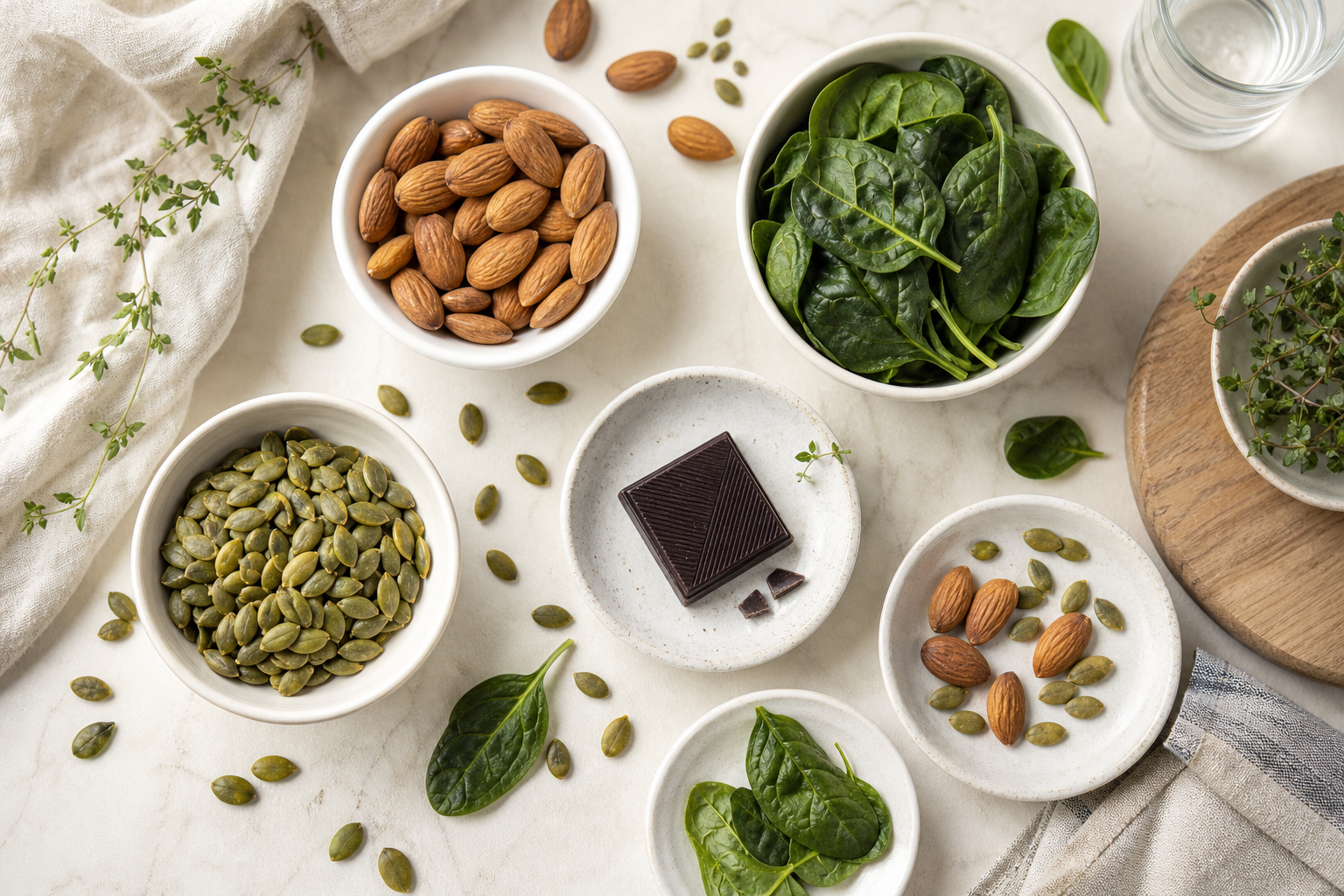
For most healthy adults, it is unclear whether magnesium lowers stress. The trials that report a benefit measured stress scores in narrow groups — otherwise healthy adults with low blood magnesium, and a subgroup of fibromyalgia patients — or tested magnesium inside a multi-ingredient blend, which leaves the ingredient responsible unidentified. If your magnesium intake is adequate and you have no diagnosis, the evidence does not tell you that a supplement will change how stressed you feel. If your magnesium status is low, the case is stronger, but it is still built on a small number of trials.
What do magnesium trials mean by stress?
In supplement trials, stress usually means a score on a standardised questionnaire. Participants rate how often they felt tense, irritable or unable to relax over a set period, and the score is compared before and after.
A lower score is a real change in what people report. It is not the same thing as fewer sick days, lower blood pressure or a lower risk of burnout. Those would be clinically meaningful outcomes, and none of the trials discussed below reported them as their main result.
The questionnaire score sits between a laboratory measurement and a life outcome. Keep that position in mind when a label promises that a product helps you stay calm or relaxed.
What did trials in people with low magnesium find?
The most relevant population is otherwise healthy adults with low serum magnesium and severe or extremely severe stress. Serum magnesium is the level measured in the liquid part of the blood. The paper cited here is a post-hoc secondary analysis of an 8-week Phase IV randomised trial in that group: adults scoring above 18 on the DASS-42 stress subscale were randomised 1:1 to magnesium with vitamin B6 (300 mg magnesium and 30 mg B6 daily) or to magnesium alone (300 mg daily).
What this analysis reports is this. DASS-42 anxiety and depression scores improved significantly from baseline to week 8 with both treatments, most of it during the first four weeks, and quality-of-life scores kept improving across the full eight weeks. The only outcome on which the combination beat magnesium alone was participants’ perceived capacity for physical activity in daily life, at week 4. The authors’ own conclusion is that magnesium with or without vitamin B6 could provide a meaningful clinical benefit in daily life for people with stress and low magnesemia.
The sentence that greater stress reduction was achieved with the combination than with magnesium alone belongs to the background of this paper, where it describes the parent trial’s own stress endpoint. It is not a finding of the analysis cited here, and this analysis does not pick a winner between the two arms.
Two limits here are structural rather than incidental. Both arms received an active product, so nothing in this comparison tells you how magnesium performs against a placebo: an improvement from baseline in both arms is equally consistent with a treatment effect, with regression to the mean and with a stressful period simply passing. And the two tested products are branded magnesium preparations from the company that employs several of the authors, which the paper discloses. That is a reason to read the effect cautiously, not a reason to dismiss it.
For your decision, that has two consequences:
- The result was measured in people who started with low blood magnesium and high stress. It does not transfer to people with normal magnesium levels.
- It does not establish B6 as the ingredient that matters. On the outcomes this analysis reports, magnesium on its own improved them too.
What did the fibromyalgia trial find?
Fibromyalgia is a chronic condition with widespread pain and fatigue, and patients often report stress as well. One randomised, double-blind, placebo-controlled trial gave fibromyalgia patients oral magnesium at 100 mg once a day as a magnesium chloride formulation for one month, with the DASS-42 stress score as its primary endpoint.
That primary endpoint did not separate the groups. After a month the DASS-42 score had fallen in both the magnesium and the placebo arm, and the difference was not significant (21.8 ± 9.6 versus 21.6 ± 10.8, p = 0.930). The significant result the title refers to came from a subgroup: among patients whose stress was mild or moderate, the score fell from 22.1 ± 2.8 to 12.3 ± 7.0 on magnesium, while the same subgroup on placebo went from 21.9 ± 11.9 to 22.9 ± 11.9 (p = 0.003). Pain severity also improved on magnesium (p = 0.029); the other secondary endpoints did not differ between the groups.
A subgroup finding after a null primary endpoint is a hypothesis, not a demonstration, and the authors treat it as one: they describe the wider evidence for magnesium in fibromyalgia as still poor even though supplementation seems to help, and they call for a larger clinical trial. That candour matters, and so does the order of those two results — the headline effect appears only once you look inside the trial rather than at it.
This is one short trial, in people with a specific chronic pain condition and moderate stress. It may be relevant to fibromyalgia patients. It is not evidence for stressed adults who do not have fibromyalgia.
Was any trial run in stressed but otherwise healthy adults?
One was, and it is the reason this answer is “unclear” rather than “no”. A 28-day randomised, placebo-controlled trial enrolled 100 adults who had been stressed for at least a month and scored 14 or more on DASS-42, without screening for low magnesium first. The DASS-42 stress score fell further on the supplement than on placebo (effect size 0.29, 95% CI 0.01 to 0.57, p = 0.04), with similar reductions at day 14 and at day 56.
The catch is what was in the capsule. The tested product combined magnesium with vitamins B6, B9 and B12, rhodiola and green tea extract supplying L-theanine. A placebo-controlled result for that blend cannot be reassigned to magnesium, and the authors do not claim otherwise. The size is worth reading too: an effect size of 0.29 whose confidence interval nearly touches zero is a small, barely separated difference, not a transformation.
The wider picture comes from a systematic review of magnesium supplementation and subjective anxiety and stress. It found 18 studies, every one of which recruited people on an existing vulnerability to anxiety — mildly anxious adults, premenstrual syndrome, postpartum status, hypertension — with positive effects in four of eight anxious samples, four of seven premenstrual samples and one of two hypertensive samples, and no effect on postpartum anxiety. Its conclusion is that the evidence is suggestive of a benefit on subjective anxiety in vulnerable groups and that its quality is poor. The review also records that no study in it administered a validated measure of subjective stress as an outcome — worth holding next to any label that sells magnesium for stress.
Who is this answer not for?
People with normal magnesium status who want magnesium on its own. The two results that isolate magnesium come from groups with a reason to respond: low blood magnesium in one trial, a chronic pain condition in the other. Baseline status works as a gate, and a result measured in deficient people is not an answer for people who are not. The one trial that did not screen for low magnesium tested a five-ingredient blend. If you have already tried magnesium and felt nothing, why magnesium may not seem to work is a separate question with its own article.
People with a diagnosed anxiety disorder. Everyday stress and a diagnosed anxiety disorder are different conditions. An anxiety disorder has its own clinical treatments and its own trial literature. Trials of stressed but otherwise healthy adults say nothing about whether magnesium can stand in for that care. If symptoms persist for weeks or disrupt work and sleep, that is the point where the decision becomes a clinician's.
People treating depression. Magnesium has been studied in depression as a separate question. A stress trial is not evidence for depression, and the reverse is also true.
Anyone relying on a single blood test. Also known as serum magnesium or blood magnesium, this test captures only a small fraction of the body's magnesium. Most of it is stored in bone and inside cells. A normal result does not rule out low body stores, and a low result is a reasonable flag but not a full picture.
What are the drawbacks?
Combination products blur the evidence. Many products sold for stress combine magnesium with B vitamins, herbal extracts or L-theanine. A finding for one exact blend does not transfer to a different blend. It does not transfer to magnesium alone either, and the reverse also holds. When several ingredients are tested together, nobody can say which one did the work.
Digestive effects. Oral magnesium has a dose-dependent laxative effect, caused by an osmotic effect in the gut: unabsorbed magnesium draws water into the bowel. Some forms produce this effect more readily than others.
Kidney function and medicines. The kidneys clear excess magnesium. In people with reduced kidney function, magnesium can accumulate, so supplementation needs medical oversight. Magnesium can also reduce the absorption of some medicines taken at the same time, including certain antibiotics and bisphosphonates, so the timing of doses matters for anyone on regular medication.
Small, short trials. None of these trials ran longer than eight weeks, and the only one with a placebo arm in stressed healthy adults enrolled 100 people. What happens with months of use, or after stopping, is not well characterised.
How is magnesium supposed to work on stress?
The chemistry is the strongest part of the story. The magnesium ion physically sits in the channel of the NMDA receptor, a receptor on nerve cells that responds to the excitatory messenger glutamate, and blocks it at rest. That much is established neurochemistry.
Researchers have also proposed that magnesium influences the hormonal stress-response system and that stress itself may deplete magnesium. These are hypotheses with a plausible rationale. They are not demonstrated pathways to a lower stress score in humans.
None of this shows that a capsule changes how stressed you feel. A mechanism explains why an effect would be plausible. Whether the effect occurs is a separate question, answered only by trials in people.
A receptor that magnesium can block in a nerve cell is not, by itself, a calmer week.
Which features of a magnesium product matter for stress?
Ranked by the strength of evidence behind each, not by how prominently labels advertise them:
- Whether you are likely to be low in magnesium. Signs include a poor diet, some medicines and certain medical conditions. This criterion has direct human outcome evidence in a narrow form: the trial whose authors describe a meaningful clinical benefit enrolled people with low serum magnesium and severe stress, and they frame that benefit as applying to such people.
- Whether the product adds vitamin B6. Weaker than it looks. The one analysis that compared magnesium with B6 against magnesium alone concluded that both helped, and separated the arms only on perceived capacity for physical activity at week 4. B6 is not established as the ingredient doing the work.
- The specific magnesium form (glycinate, citrate, chloride, oxide and others). For stress outcomes this is untested in the evidence cited here: none of these sources compares one magnesium form with another on a stress score. Forms do differ in solubility and absorption, which is mechanistically plausible as a reason to care. Higher absorption is not the same as a larger reduction in stress.
- Multi-ingredient stress blends. One specific blend — magnesium with B6, B9, B12, rhodiola and L-theanine — does have a placebo-controlled result in stressed healthy adults, and it is the only placebo-controlled stress result cited here. It vouches for that formula and no other, and it cannot say which ingredient did the work. For any other combination, attribution is untested.
- Claims such as calming, relaxing or anti-stress. At best these are mechanistically plausible. They describe chemistry, not a trial result.
An expensive form marketed for stress has not shown an advantage on stress outcomes over a cheaper, well-absorbed form. I would not pay a premium for one on that claim.
Verdict
The answer depends on your goal and your starting point.
- Healthy adults with adequate intake who feel stressed: unclear. The one placebo-controlled trial run in your situation tested a five-ingredient blend, so it cannot tell you that magnesium was the active part, and its effect was small. For magnesium on its own in this group there is no placebo-controlled stress result here at all.
- Adults with low magnesium and severe stress: magnesium may help, with or without added B6 — that “with or without” is the cited authors’ own wording. It rests mainly on one 8-week trial that compared two active regimens with no placebo arm.
- People with fibromyalgia: one short trial missed its primary endpoint against placebo and found less stress only in its mild-to-moderate subgroup, in a field the authors themselves describe as weakly evidenced.
- Anyone with a diagnosed anxiety disorder or depression: stress trials are not the evidence base for your decision.
The rule to carry forward is this. Before acting on any stress supplement claim, ask three questions. Was the trial run in people like you, with your starting magnesium status? Did it test this exact product, rather than a different blend or form? And did it measure a stress outcome, or only a mechanism dressed up as one? If any answer is no, the claim has not yet earned your money.
Sources
- Effect of magnesium and vitamin B6 supplementation on mental health and quality of life in stressed healthy adults: Post-hoc analysis of a randomised controlled trial (Stress Health, 2021)
- Short-Term Magnesium Therapy Alleviates Moderate Stress in Patients with Fibromyalgia: A Randomized Double-Blind Clinical Trial (Nutrients, 2022)
- Effect of a Combination of Magnesium, B Vitamins, Rhodiola, and Green Tea (L-Theanine) on Chronically Stressed Healthy Individuals — A Randomized, Placebo-Controlled Study (Nutrients, 2022)
- The Effects of Magnesium Supplementation on Subjective Anxiety and Stress — A Systematic Review (Nutrients, 2017)