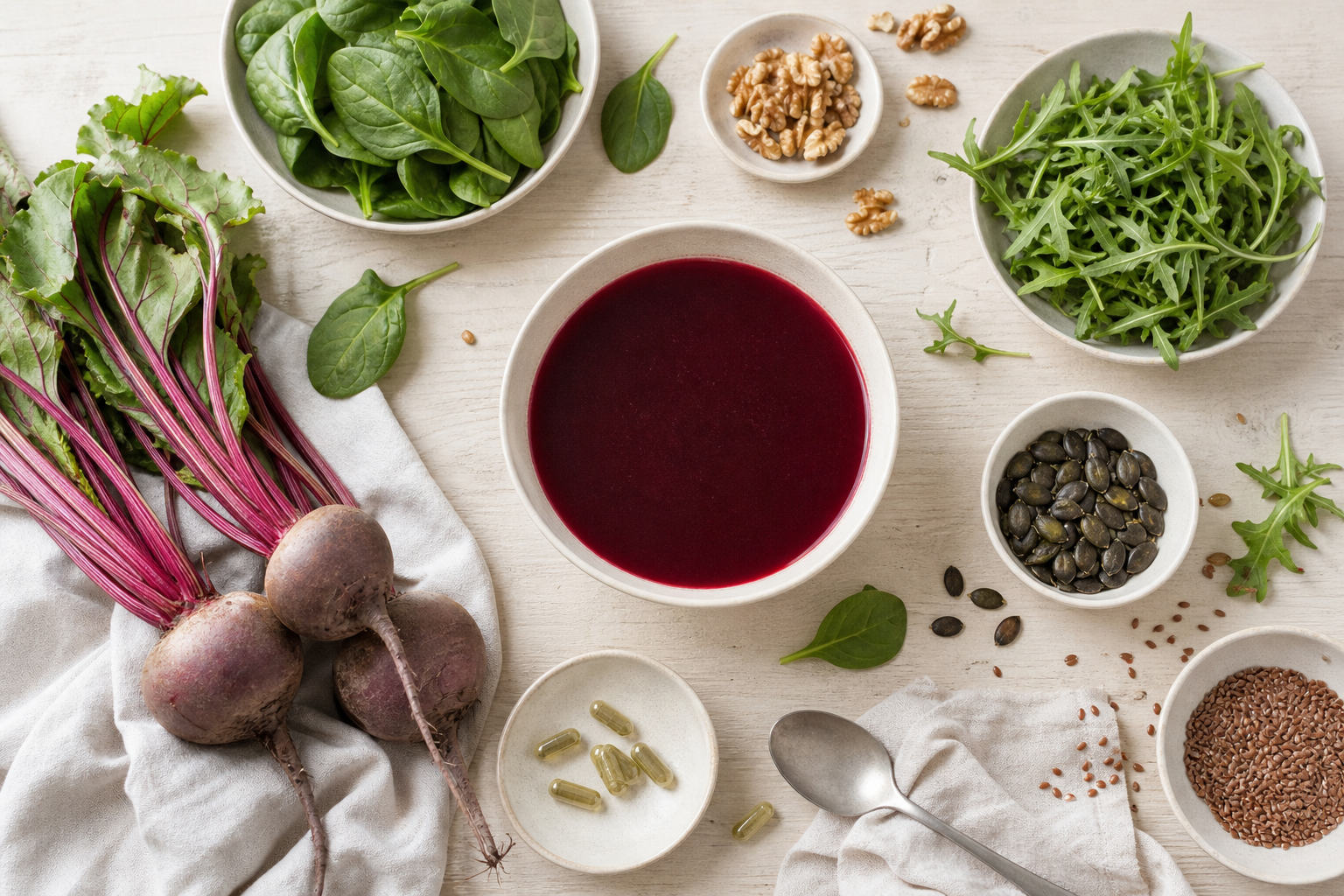
Beetroot juice is dosed in millimoles of nitrate, not millilitres of juice. In the dose-response study most often used to set pre-exercise dosing, about 8.4 mmol of nitrate (140 ml of concentrated juice) taken 2.5 hours before exercise lengthened time to exhaustion in hard cycling by 14% compared with a nitrate-free placebo. Doubling the dose to 16.8 mmol added nothing further, and half the dose (4.2 mmol) changed nothing. That trial involved ten healthy young men on a bike, not runners on a course, so it tells you the dose and the timing more reliably than it tells you your race result.
What is actually being dosed, and how much?
The active substance is the inorganic nitrate ion. Beetroot is one way to deliver it; rocket, spinach and chard are others. This matters when you shop, because a label can advertise beetroot generously while saying nothing about the only quantity the research is built on.
Four numbers tend to get merged in this category:
- Daily requirement. There is none. Nitrate is not an essential nutrient, so a pre-run dose is not correcting a deficiency.
- What the body already makes. Nitric oxide is produced from l-arginine by nitric oxide synthase. The dietary route – nitrate to nitrite to nitric oxide – runs alongside it.
- The dose that was studied. In the dose-response trial, 70, 140 and 280 ml of concentrated juice supplied 4.2, 8.4 and 16.8 mmol of nitrate. Only the two higher doses changed exercise responses.
- The dose in your product. Nitrate content varies with crop, soil and processing. A product that states millilitres of juice, or milligrams of "beetroot extract", has not told you its nitrate dose. For reference, 8.4 mmol of nitrate is roughly 520 mg of nitrate ion. Without a nitrate figure per serving, you cannot match the studied dose.
Plasma nitrite rising after a dose shows that the nitrate arrived and was converted. It is a measure of exposure, not of performance.
How long before a run?
In the same trial, plasma nitrite rose in proportion to the dose and peaked about 2–3 hours after drinking the juice; the exercise tests were done 2.5 hours after ingestion. That is the practical basis for taking the dose two to three hours before the start rather than during the warm-up.
The delay follows from the route nitrate takes. Bacteria in the mouth reduce nitrate to nitrite, which raises circulating nitrite; nitrite can then be reduced to nitric oxide where oxygen is scarce. Because the oral bacterial step is part of that chain, an antibacterial mouthwash used around the time of the dose would be expected to blunt the effect. That is a prediction from the pathway, not a result from the studies cited here, but it costs nothing to avoid.
Still untested in these studies: whether several days of dosing before a race beats a single dose on the day, and whether taking it with food changes the outcome.
What did the human studies actually measure?
- Exercise tolerance in cycling. At 8.4 and 16.8 mmol, time to task failure in severe-intensity cycling increased by 14% and 12%, and the oxygen cost of moderate exercise fell (by 3.0% at the highest dose). Time to exhaustion at a fixed load is not the same as a time trial, and the participants were healthy young men, not trained distance runners.
- Repeated sprints. A separate study found that dietary nitrate improved repeated sprint performance during prolonged intermittent exercise and may have limited the decline in reaction time. That pattern resembles team sports and interval sessions more than steady distance running.
- Blood pressure. Beetroot juice supplying about 5–8 mmol of nitrate lowers blood pressure. That is a cardiovascular effect in its own right, not a running result.
None of the studies cited here compares juice, gels, powders or capsules against each other on a running outcome.
Who probably gains little?
- Anyone taking a small serving. 4.2 mmol did not change exercise responses in the dose-response trial.
- Anyone taking more than the effective dose. 16.8 mmol gave no additional benefit over 8.4 mmol.
- Anyone whose product does not declare nitrate content. There is no way to know whether the effective dose is being reproduced.
- Anyone using antibacterial mouthwash around the dose, for the reason given above.
Whether well-trained distance runners respond as much as the healthy but not specifically trained men in the dose-response trial is not answered by the studies cited here.
Side effects and medication
Pink or red urine and stool after beetroot is harmless and comes from the plant's pigments, not from nitrate. A large volume of concentrated juice shortly before a run can also upset the stomach, so try it in training before a race.
Because beetroot juice at these doses lowers blood pressure, anyone taking blood-pressure medication or a prescribed nitrate for angina should ask their doctor before using it regularly, since both act on the same endpoint.
Verdict
If you want to try beetroot juice before a race or a hard session, the dose with evidence behind it is about 8 mmol of nitrate (around 500 mg of nitrate ion), taken 2–3 hours before the start. Less did nothing in the dose-response trial, and more added nothing. Buy only a product that states its nitrate content per serving. Expect a small effect: the clearest results come from cycling to exhaustion and from repeated sprints, not from distance races. Test it in several comparable training sessions before relying on it on race day, and if your times do not change, there is nothing further to buy.
Sources
- Beetroot juice and exercise: pharmacodynamic and dose-response relationships (J Appl Physiol, 2013) – doses 4.2, 8.4 and 16.8 mmol; peak plasma nitrite at about 2–3 h; time to task failure +14% and +12% at 8.4 and 16.8 mmol; no effect at 4.2 mmol; blood-pressure effect of 5–8 mmol.
- Dietary Nitrate and Nitric Oxide Metabolism: Mouth, Circulation, Skeletal Muscle, and Exercise Performance (Med Sci Sports Exerc, 2021) – routes of nitric oxide production and the role of oral bacteria.
- Dietary nitrate improves sprint performance and cognitive function during prolonged intermittent exercise (Eur J Appl Physiol, 2015) – repeated sprint performance and reaction time.