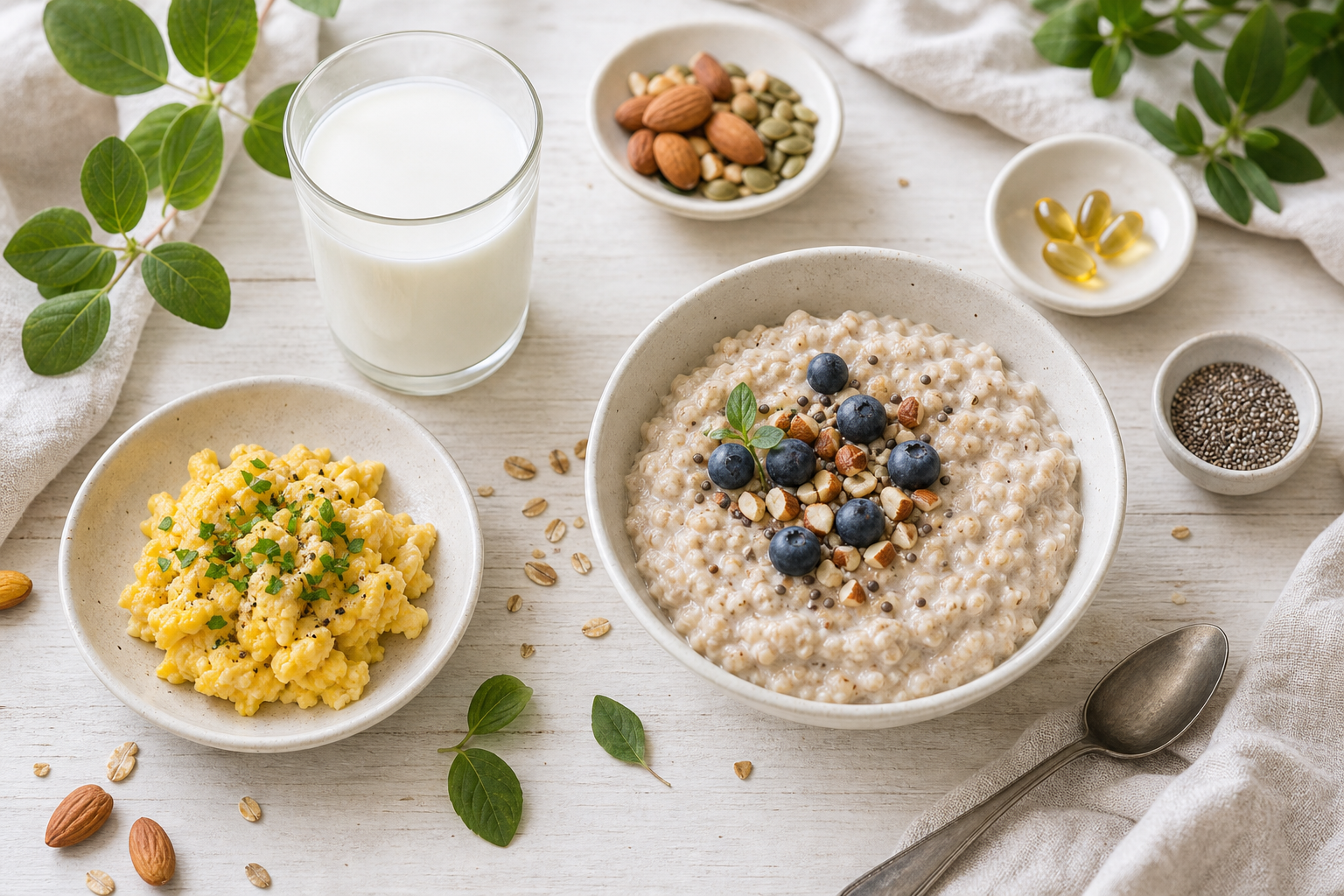
If your diet is genuinely good, a daily multivitamin probably does very little for you, and no large trial has shown it prevents the diseases people buy it to prevent. The honest answer is conditional: a broad multivitamin is insurance against specific gaps, not a source of extra health on top of an already adequate diet. Whether you need that insurance depends on whether you actually have a gap – and "good diet" and "no gaps" are not the same thing.
Treating a diagnosed deficiency, pregnancy, and single-nutrient supplements taken for a specific reason are different decisions with different evidence, and they are left aside here.
What does "a good diet" actually settle?
A good diet settles the question of intake for most nutrients, most of the time. If you regularly eat vegetables, fruit, whole grains, some protein source, and dairy or its alternatives, you are almost certainly meeting the reference intake for the large majority of vitamins and minerals. A multivitamin then adds those same nutrients on top of an amount that was already enough. For a water-soluble vitamin, the surplus is largely excreted. That is the core reason the benefit is small: you cannot correct a deficiency you do not have.
What a good diet does not automatically settle is a handful of nutrients that are genuinely hard to get from food alone, or that depend on factors food cannot control. Vitamin D is the clearest case – for most people at higher latitudes it depends more on sunlight than on diet. Vitamin B12 is difficult to obtain from a fully plant-based diet without fortified foods or a supplement, because it is essentially absent from unfortified plant sources. Iron intake and iron status diverge for people who menstruate. Iodine and folate can fall short depending on food choices and life stage.
The practical consequence: "my diet is good" is a reasonable answer for the average nutrient, but it is not an answer for these specific ones. A multivitamin is a blunt instrument for that problem – it delivers a little of everything, including the nutrients you already had covered, to reach the few you might not.
Does a multivitamin prevent disease in well-nourished people?
Here the direction of the evidence is clear enough to state plainly: in generally well-nourished adults, routine multivitamin use has not been shown to reduce the main outcomes people take it for. In the Physicians' Health Study II, 14,641 male US doctors aged 50 or older took a daily multivitamin or placebo for more than a decade; the multivitamin did not reduce major cardiovascular events, heart attacks, strokes or cardiovascular deaths. The more recent COSMOS trial, in 21,442 older US adults followed for a median of 3.6 years, found no significant effect on cardiovascular events (HR 0.98) and no significant effect on death from any cause. And in three large US cohorts totalling about 390,000 adults, daily multivitamin users did not live longer than non-users. The reasonable reading is that a multivitamin does not lower the risk of the big chronic-disease outcomes in people who are not deficient.
Cancer is a more mixed picture. In the Physicians' Health Study II, men taking the multivitamin had 8% fewer total cancers over about 11 years (HR 0.92, 95% CI 0.86–0.998) – a result that only just reached statistical significance and did not reduce cancer deaths. COSMOS, in older men and women, found no reduction in total cancer (HR 0.97). It is not a reason to expect a multivitamin to protect you, and it is not nothing either. It is best treated as an open question rather than a benefit you can bank on.
Cognition follows a similar pattern: in COSMOS-Web, 3,562 older adults taking a daily multivitamin scored modestly better than the placebo group on an immediate word-recall test after one year, but a modest change on a test is an intermediate result, not a demonstration that a person's day-to-day cognition or long-term dementia risk changes. The gap between "scored slightly better on a task" and "is meaningfully sharper or protected from decline" is exactly the gap this kind of evidence does not close.
The fair summary is this: for hard outcomes in well-nourished adults, the evidence points to little or no benefit; for softer outcomes, small signals exist that have not settled into anything you can rely on.
The US Preventive Services Task Force was more cautious still in 2022: it judged the evidence insufficient to weigh benefits against harms of multivitamins for preventing cardiovascular disease or cancer, and recommended against beta-carotene and vitamin E supplements for that purpose.
Is there any downside to taking one anyway?
For a standard multivitamin at label doses, the risk to a healthy adult is low, which is part of why they sell so well – the cost of being wrong feels trivial. But "low risk" is not "no reason to think about it," and there are three specific points worth holding.
- Fat-soluble vitamins accumulate. Vitamins A, D, E and K are stored rather than flushed out, so stacking a multivitamin on top of fortified foods and other supplements is how people quietly reach a high intake. Vitamin A in particular has a meaningful upper limit.
- More is not better past adequacy. Once you have enough of a nutrient, adding more does not add function. The mental model of "topping up" implies a benefit that does not exist above the point of sufficiency.
- It can mask the real question. A multivitamin gives a small dose of everything, which is a poor tool if you have one genuine gap that needs a proper dose. Someone low in vitamin D or B12 needs an adequate amount of that nutrient, not a trace of forty.
None of this makes a general-purpose multivitamin dangerous for a healthy person. It makes it, at best, low-value insurance – and occasionally a way to avoid answering the more useful question.
Who is the answer "no" for, and who might it be "yes" for?
If you eat a varied diet, have no diagnosed deficiency, and are not in a life stage with elevated needs, the evidence does not support a multivitamin as a way to improve your health or lower your disease risk. For you, the honest answer is that it is unlikely to do much, and "good diet" is doing the work you hoped the pill would.
The answer shifts towards "reasonable" for people whose intake or status is plausibly short despite reasonable eating: those on a fully plant-based diet (chiefly for B12), people with limited sun exposure (vitamin D), those who menstruate heavily (iron), older adults whose absorption of B12 declines with age, and anyone eating a genuinely restricted diet by choice or circumstance. Even for these groups, note what the logic actually recommends: a targeted supplement at an adequate dose usually addresses the specific gap better than a broad multivitamin does.
Pregnancy and planning pregnancy are a separate, well-established case built around folate and a small number of other nutrients, and they are not covered by "do I need a general multivitamin."
The more useful question than the one you asked
"Do I need a multivitamin?" is usually the less useful question. The one that changes your decision is: which specific nutrient, if any, am I actually short of? That is answerable – by looking honestly at your diet, your life stage, and where relevant a blood test – in a way that "should I take a general multivitamin" is not.
The decision rule that outlasts any single product: buy for a gap you can name, not for reassurance. If you can name the nutrient and the reason, a targeted supplement at an adequate dose is the sensible route. If you cannot name one, a multivitamin is spending money to cover a shortfall you have no evidence of having. A good diet has already done the part the marketing is selling back to you.
Sources
- Multivitamins in the prevention of cardiovascular disease in men: the Physicians' Health Study II (JAMA, 2012) – no reduction in major cardiovascular events, MI, stroke or CVD mortality after more than a decade. PMID 23117775.
- Multivitamins in the prevention of cancer in men: the Physicians' Health Study II (JAMA, 2012) – total cancer HR 0.92 (0.86–0.998); no significant effect on cancer mortality. PMID 23162860.
- Multivitamins in the prevention of cancer and cardiovascular disease: COSMOS (Am J Clin Nutr, 2022) – no significant effect on total cancer, cardiovascular events or all-cause mortality in 21,442 older adults. PMID 35294969.
- Multivitamin supplementation improves memory in older adults: COSMOS-Web (Am J Clin Nutr, 2023) – better immediate recall at one year versus placebo in 3,562 older adults. PMID 37244291.
- Multivitamin use and mortality risk in 3 prospective US cohorts (JAMA Netw Open, 2024) – multivitamin use not associated with lower all-cause mortality in 390,124 adults. PMID 38922615.
- Vitamin, mineral, and multivitamin supplementation to prevent cardiovascular disease and cancer: USPSTF recommendation statement (JAMA, 2022) – evidence insufficient for multivitamins; recommendation against beta-carotene and vitamin E. PMID 35727271.