Urolithin A is unusual among longevity ingredients: it has randomized human trial data, not just cell-culture enthusiasm. What that data measured, though, is muscle function and mitochondrial biomarkers in middle-aged adults — not lifespan, not disease risk, not "ageing" as a whole. The gap between those two statements is the entire question worth asking before spending money on it.
What is urolithin A, and what is Mitopure?
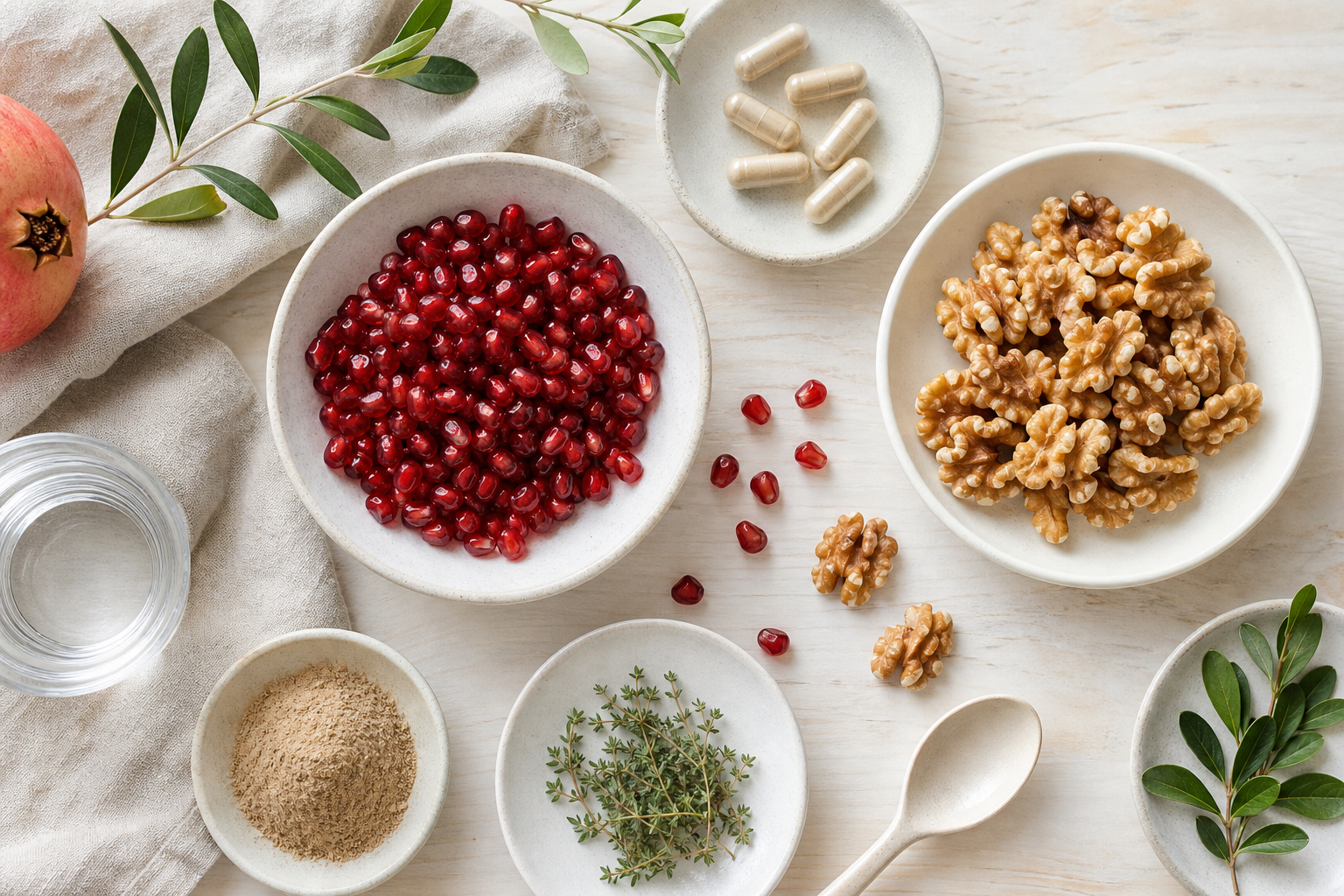
Urolithin A is not a plant compound. It is a gut bacterial metabolite. When you eat pomegranates, walnuts, or certain berries, you consume ellagitannins — large polyphenols that your own enzymes cannot do much with. Gut bacteria hydrolyse them to ellagic acid and then, in a further set of reactions, convert ellagic acid into urolithins A, B, C and D. Urolithin A is the one that has attracted the research attention.
Mitopure is a branded, synthesised form of urolithin A produced by Timeline. Chemically it is the same molecule that some people's gut bacteria make; the branding refers to a manufacturing and standardisation process, not to a different compound. This matters for how you read the evidence: results obtained with a standardised urolithin A preparation apply to urolithin A, and a generic product delivering the same molecule at the same dose is working from the same chemistry.
Not to be confused with: ellagic acid (the precursor, not the active metabolite), pomegranate extract or pomegranate juice (which supply precursors and depend entirely on your microbiome), and urolithin B (a different metabolite with a much thinner evidence base). A label saying "pomegranate ellagitannins" is not a label saying urolithin A.
Why can't you just eat pomegranates?
Because conversion is a microbiome trait, not a universal human one. The bacterial species capable of performing the full conversion to urolithin A are not present in everyone's colon, and the amount produced varies substantially between people who do carry them. This is the single strongest argument for supplementing the finished metabolite rather than the precursor: it removes a conversion step that a meaningful fraction of people cannot reliably perform.
That argument is about exposure, and it is well founded at that level. It is not, by itself, evidence that raising urolithin A exposure produces a health benefit. Those are different claims sitting at different rungs of the evidence ladder, and supplement marketing routinely collapses them into one.
What has actually been shown in humans?
The most substantive human result to date comes from a randomized trial in middle-aged adults, published in Cell Reports Medicine in 2022, reporting that urolithin A improved muscle strength, exercise performance, and biomarkers of mitochondrial health. Three things in that sentence deserve separating:
- Biomarkers of mitochondrial health — these are laboratory measures. A favourable shift here is a signal that the molecule is doing something biologically, not a demonstration that a person is healthier. Confidence level: supported as a biological signal.
- Muscle strength — a functional intermediate outcome, and the more interesting of the two. Strength in midlife tracks with later-life independence, but tracking with an outcome is not the same as having improved that outcome. Confidence level: supported, in this population, over this trial's duration.
- Exercise performance — again functional, again intermediate.
What that trial does not establish is a clinically meaningful long-term outcome: no reduction in falls, frailty, disability, disease incidence or mortality was demonstrated, because those were not what it measured. I would treat the finding as a genuine positive human signal in a field where most "longevity" ingredients cannot produce one — and stop there.
A second randomized, placebo-controlled trial, examining urolithin A as a mitophagy inducer in the context of age-related immune decline, appeared in Nature Aging in 2025. I flag it because it shows where the research programme is heading — from skeletal muscle towards immune ageing — but I am not going to characterise its result here. I have not been able to verify the reported direction or magnitude of effect from the abstract text available to me, and a title is not a finding.
Where does the evidence run out?
Several places, and they all matter for a purchase decision.
Duration and endpoint. Human trials of urolithin A are short relative to the timescale of the claims made for it. "Supports healthy ageing" is a decades-long claim being marketed on the basis of weeks-to-months data on strength and biomarkers. That is not fraud; it is extrapolation, and it should be labelled as such.
No head-to-head comparisons. I have not found a published human trial comparing urolithin A against resistance training, creatine, protein supplementation, or any other intervention with established effects on muscle function in midlife. Two separate placebo-controlled results do not compose into a ranking. So the practical question most readers actually have — is this a better use of money than the cheap, well-studied options? — is unanswered by direct evidence.
Population. The muscle findings come from middle-aged adults. Whether the same effect appears in trained athletes, in frail older people, or in people with mitochondrial or metabolic disease is a separate empirical question. Extending the result to those groups is inference, not data.
Cost. Urolithin A is among the more expensive supplement ingredients per month of use. That is a legitimate part of the evidence calculus: the same money buys a great deal of protein, creatine, or a gym membership, all of which have larger and longer human evidence bases for muscle outcomes.
How is it supposed to work?
The proposed mechanism is mitophagy — the selective autophagic clearance of damaged mitochondria. Mitochondria accumulate oxidative damage; damaged organelles are less efficient and leak more reactive species; a cell that cannot recycle them efficiently accumulates dysfunctional ones. Mitophagy is the quality-control pathway that tags and degrades them, and its efficiency is generally thought to decline with age. Urolithin A is characterised as an inducer of this pathway, which is a coherent story for why a mitochondria-dense tissue like skeletal muscle would be the first place an effect shows up.
This is a mechanism, and it should be read as one. Mechanistic plausibility explains why the muscle findings are not surprising; it does not add evidential weight to them, and it certainly does not license the leap from "induces mitophagy" to "slows ageing". Much of the mitophagy work underpinning the concept comes from model organisms, where lifespan can be measured directly and where results transfer to human oral dosing unreliably.
Who has a plausible reason to try it — and who does not?
The narrowest defensible case: a middle-aged adult who is already doing the high-evidence things — resistance training, adequate protein, sleep — and who wants to add something with a positive randomized human result on muscle function, accepting that the outcome measured was strength and performance rather than any long-term health endpoint.
The weakest cases: anyone buying it as a lifespan intervention (no human lifespan data exists for it); anyone using it as a substitute for training (the trial evidence concerns supplementation, not replacement of exercise); and anyone whose baseline protein intake and training are not in place, where the same money buys far more demonstrated benefit elsewhere.
What should you look at on a label?
Ranked by the strength of evidence behind each criterion, not by how prominently it is marketed:
- Does the product deliver urolithin A itself, at a stated milligram dose per serving? — direct human outcome evidence. The randomized trial data concerns the metabolite. A pomegranate extract supplying precursors is a different product relying on your microbiome to finish the job.
- Does the dose match what was used in the published human trials? — biomarker-supported. Underdosing to hit a price point is the most common way a product becomes chemically correct and practically irrelevant.
- Independent purity and identity testing. — quality assurance, not efficacy evidence. It tells you the molecule is present and clean; it tells you nothing about whether it works.
- Delivery claims — "liposomal", "enhanced absorption", proprietary carriers. — mechanistically plausible at best, and untested for this compound in comparative human trials as far as I can determine. Absorption-enhancement claims for urolithin A have not, to my knowledge, been demonstrated to produce superior clinical outcomes against a standard preparation.
- Bundled formulas — urolithin A blended into protein powders, collagen, or multi-ingredient "longevity" stacks. — untested as combinations. You are paying for a mixture that no trial evaluated, and usually cannot verify the urolithin A dose within it.
Verdict
Urolithin A clears a bar most longevity ingredients do not: a randomized human trial reported improvements in muscle strength, exercise performance and mitochondrial biomarkers in middle-aged adults. That is real, and it is worth taking seriously. It is also, precisely, a muscle-function and biomarker result — not a demonstrated effect on how long or how well you live, and not a result that has been compared head-to-head against the cheap interventions that address the same tissue.
If you have the budget after the high-evidence basics are in place, the rationale is defensible and the mechanism is coherent. If you are choosing between this and resistance training with adequate protein, the choice is not close, and no published human comparison suggests otherwise. Buy it, if you buy it, as a well-evidenced muscle-function ingredient with an interesting mechanism — not as a longevity drug, which nothing yet shows it to be.