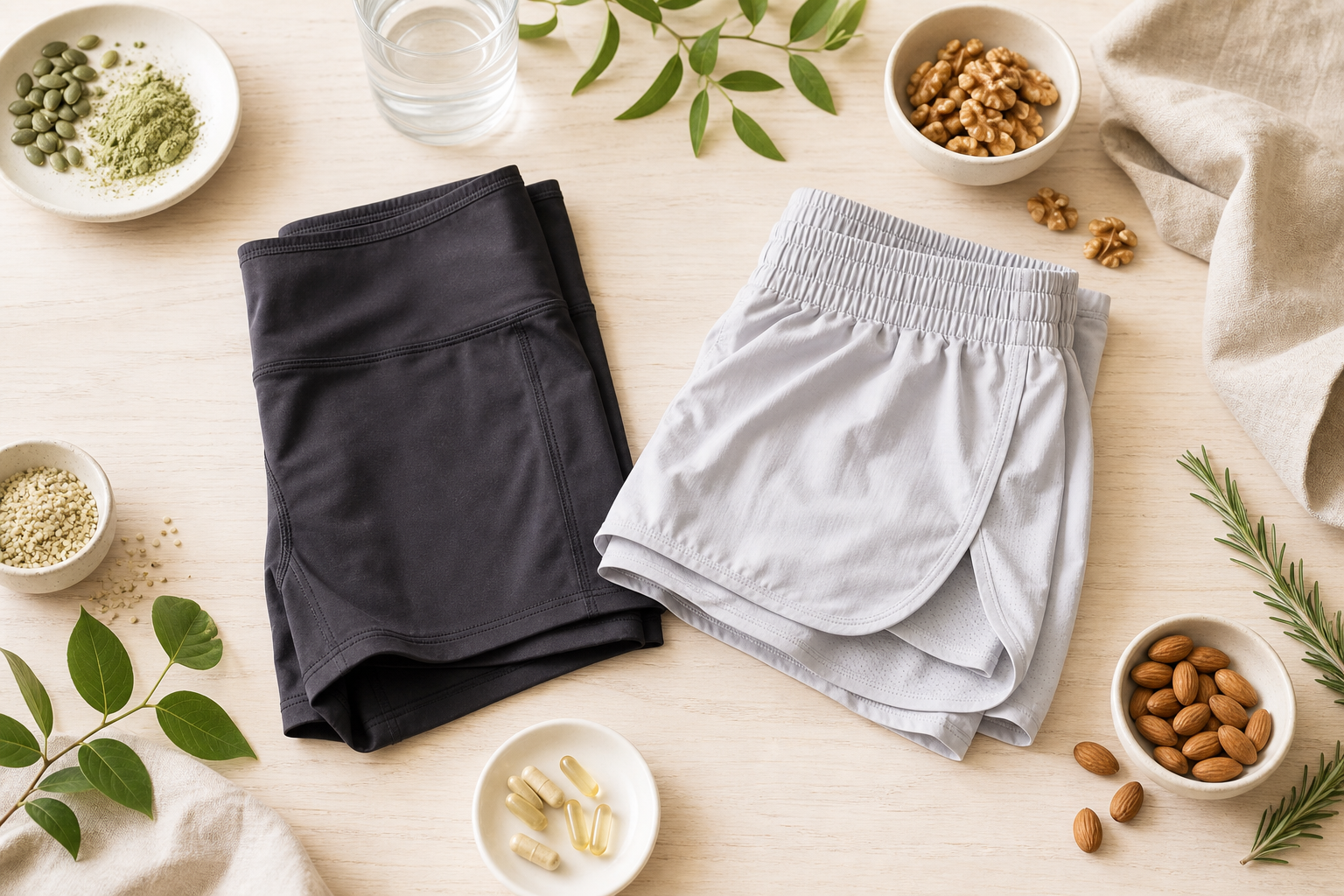
Two shorts from the same brand, ten dollars apart. The question worth asking before you pay the difference is not which fabric sounds better — it is which of the two specifications answers a problem you can name. Everything below comes from the brand’s own published specifications, read on 15 September 2026. Neither pair has been worn or tested here.
What each pair actually specifies
The Avigate 4-inch Mercy short lists at $54. Its declared blend is 92% polyester and 8% spandex, marketed as “AC Chill Fabric” with “laser cut panels for breathability”. It is high-waisted, carries a full brief liner, and has one zip pocket. The product page describes the cut as fitting slim, and buyer reviews on that page say it runs small, with at least one recommending sizing up.
The Flexion 5-inch compression short lists at $64. Its declared blend is 75% polyester and 25% spandex — roughly three times the stretch content. It carries four pockets: two thigh pockets described as phone-depth and two at the back. It uses a silicone hem against ride-up and a flat surge stitch at the seams. The page describes it as fitting true to size, and no brief liner is stated.
The ten dollars is not buying better fabric
Line the two up and the price gap does not isolate a fabric upgrade. It compares a lined, high-waisted, one-pocket short against an unlined, four-pocket, higher-stretch one. Those answer different problems: one carries your underwear layer, the other carries your phone.
Worth noticing which pair wears the trademarked name. “AC Chill Fabric” appears on the cheaper of the two, not the dearer. A branded fabric name is a marketing asset, not a measurement — it does not state a weight, a moisture-transport rate or a drying time, and here it does not even track price. The number that does carry information is the spandex share: 8% against 25% is a real difference in how much the fabric will give, even though neither figure tells you how either pair will feel after two hours.
The discount costs you the return
This is the part that changes the arithmetic, and it is easy to miss. At the time of writing the 5-inch pair was discounted to $44.80 — below the $54 of the 4-inch pair. But the brand’s refund policy states that only regular priced items may be refunded, and that sale items cannot be refunded.
So the cheaper checkout total is the one you cannot send back. Set against the sizing signals, the trade runs the wrong way: the pair described as true to size is the one on sale, while the pair whose own reviewers say it runs small — the one you are most likely to need to exchange — is the full-price one you can return. If you are unsure of your size, the discount is not a saving; it is a bet.
What the return window does and does not allow
The policy runs 30 days from purchase. The item must be unused, in the same condition as received, and in its original packaging; replacements are offered only for items that are defective or damaged, and return shipping is paid by the buyer and deducted from any refund.
Read literally, that permits a fit check indoors and nothing more. A run in a new pair ends the return, so the questions a run would answer — whether the waistband slides, whether the hem rides up, whether a loaded thigh pocket bounces — have to be settled before you commit, from specifications and from other people’s reports. Keep the packaging and the tags while you are still deciding.
What stays untested either way
No controlled comparison of these two pairs exists for drying time, opacity under stretch, waistband movement, pocket bounce, chafing or durability, and none is offered here. Descriptions such as breathable, streamlined or chafe-free are the brand’s claims about its own products, not measurements.
If the single reason you would pay more rests on one of those properties, the specification cannot settle it. Look for a review that names the tester’s size, the conditions and the method, or accept that you are buying on construction rather than on evidence.
How to decide
Name the problem first, then read the spec sheet against it. If inner-thigh rub is the problem, the built-in brief liner is the relevant feature and the women’s 4-inch lined short is the pair that has one. If carrying a phone and a gel without a belt is the problem, pocket count and placement decide it, and the women’s 5-inch compression short is the pair built for that. If neither problem is yours, the honest answer is that ten dollars separates two competent shorts and the choice is preference.
The rule that carries to any brand: a price gap between two shorts almost never isolates one variable. Find the specification that differs and ask whether that difference solves something you can describe. If you cannot describe it, you are paying for the name on the fabric.
Sources and method
Declared fabric blends, inseams, liner, pockets, fit guidance and prices come from the brand’s own product pages; the return terms come from its published refund policy. All were read on 15 September 2026 and change often — confirm the current variant, price and policy before buying. This is a specification comparison, not a sponsored review and not a wear test.