Does more cushioning lower your injury risk?
The honest answer is that no one can point you to a shoe and say it will keep you healthy. The evidence linking how much foam sits under your foot to whether you get injured is thin, mixed, and mostly indirect. What follows is why that is the case, where the mechanism stops being measured, and what the research can actually tell you when you are choosing a shoe.
The endpoint you care about is simple: staying uninjured and able to keep running. Almost everything the shoe industry measures sits one or two steps below that endpoint, and the gap between those measurements and your knee has not been closed.
What does "cushioning" actually change?
Start with the chain, laid out as a chain, because the joins are where the reasoning tends to break.
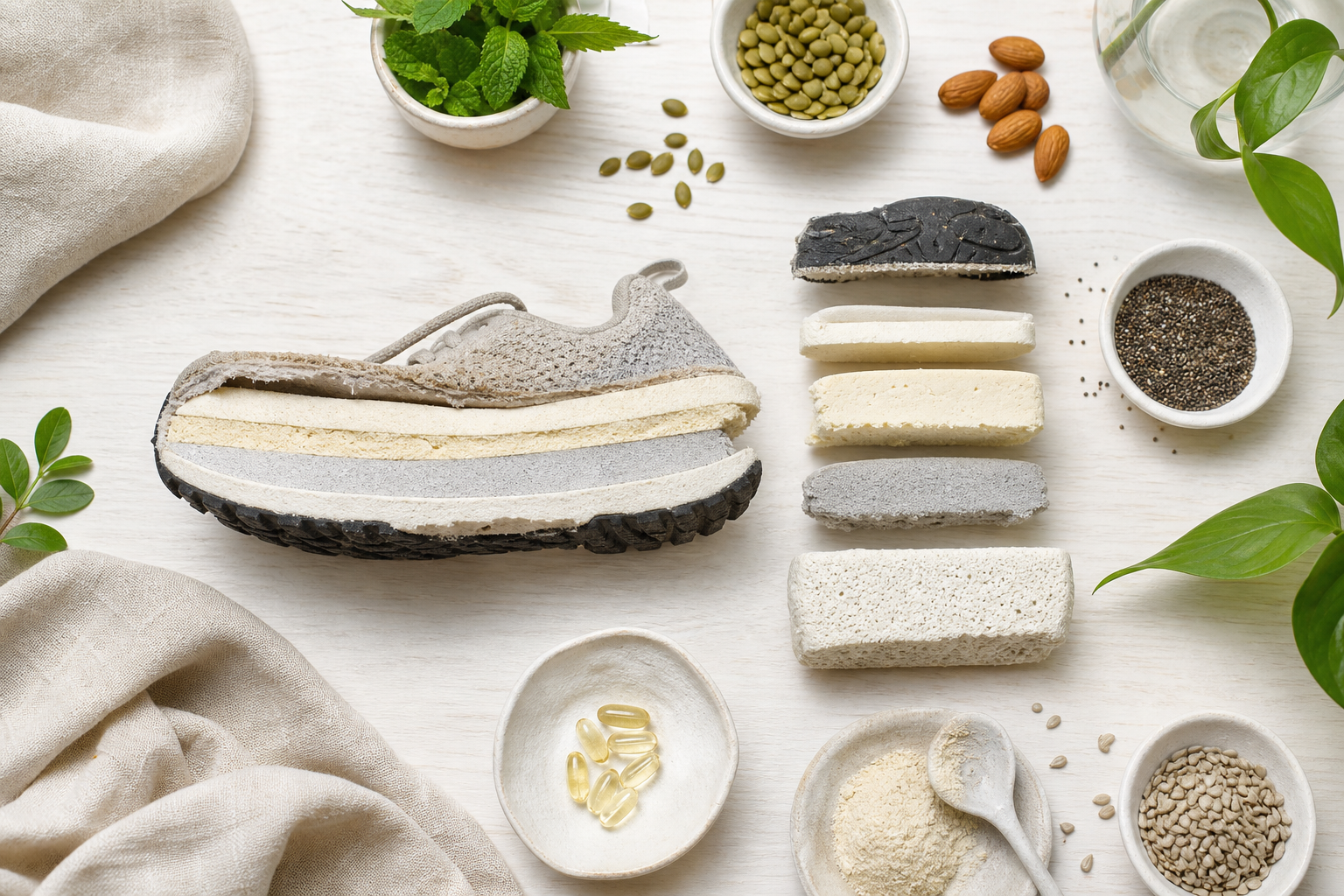
Step one is established mechanics. A softer midsole compresses more under load. This lengthens the time over which your body's downward momentum is arrested at each footstrike, and a longer deceleration time reduces the peak of certain impact forces. That much is bench physics and is not in dispute.
Step two has been measured in runners. Different midsole constructions produce different loads on the lower limb. A biomechanical study of recreational runners comparing four common footwear technologies – neutral cushioned, motion-control, maximalist carbon-plated, and others – found that the midsole technology does change the biomechanical load pattern on the lower extremities during running (Sportverletz Sportschaden, 2025). This is a real, measured difference in surrogate loading variables, not a difference in injury outcomes.
Step three is where measurement stops. Whether a lower peak impact force or a different loading pattern translates into fewer injuries, in you, over a season, has not been demonstrated. That is the link the marketing quietly steps over.
Why is impact force only a surrogate?
Peak impact force, loading rate, and ground-reaction force are all surrogates – things we can measure on a force plate in a lab, informative about mechanics, but not the same as an injury. An injury develops from repeated loading of a specific tissue over time, modified by your training load, your history, your anatomy, your mass, and the surface you run on. A single-stride force measurement captures almost none of that.
There is a plausible reason to care about impact attenuation. A secondary analysis of a large randomised trial in leisure-time runners noted that better attenuation of impact forces was related to lower injury risk, and asked whether a runner's own perception of cushioning and comfort could stand in for that hard-to-measure biomechanics (Eur J Sport Sci, 2025). That analysis did find something. Over six months in 527 recreational runners, those who perceived their shoe as moderately cushioned had about a third of the injury rate of the least-cushioned tertile (hazard ratio 0.35, 95% CI 0.19 to 0.66), and those who perceived it as highly cushioned about a quarter (0.24, 0.10 to 0.57). Those are large, statistically solid associations, and it would be dishonest to leave them out.
What they are not is proof that foam prevents injury. The exposure measured was the runner's perception of cushioning, reported during follow-up, not a shoe property assigned at random — so a runner who stayed healthy may simply have rated their shoes more kindly than one nursing a sore knee. Comfort was proposed as a practical proxy precisely because runners cannot assess their own impact forces in a shop. It tells you which shoe to trust on the day you try it on. It does not tell you that a thicker midsole would have kept you healthy.
What does the outcome evidence actually say?
Here is the part that matters most, and it is deflating. A systematic review of running shoes for preventing lower-limb injuries in adults concluded that there is genuine uncertainty about how effective running shoes are at preventing injury, and that it is unclear how specific shoe characteristics – cushioning among them – affect injury risk (Cochrane Database Syst Rev, 2022). This is a review sitting at the top of the evidence hierarchy, and it does not deliver a verdict in cushioning's favour. It reports that the question is unresolved.
So the strongest available synthesis of the outcome evidence says the chain in the first section has not been joined at the top. The mechanism is real. The surrogate differences are real. The injury benefit is not established.
What about running without cushioning?
The counter-argument runs that heavily cushioned shoes change how you land and that stripping the cushioning restores a "better" pattern. Acutely, switching from cushioned shoes to barefoot running does change biomechanics – altered ankle motion, lower ground-reaction forces, lower loading rates.
But acute is the operative word. A randomised controlled study of habituation to repeated barefoot running examined whether those acute changes persist after runners spend a period getting used to it (Am J Sports Med, 2019). The relevant point for your decision is that biomechanics adapt: a change seen in the first barefoot session is not automatically the change you keep, and neither the acute nor the habituated barefoot pattern has been shown here to lower injury rates. Less cushioning is a different loading profile, not a demonstrated route to fewer injuries.
Where does the chain break, and what would fix it?
The break is specific and worth naming plainly: no step from a shoe's measured loading profile to a runner's injury outcome has been reliably closed in humans running their own training over a meaningful period. Each individual link is defensible. The join between "this shoe changes loading" and "this shoe prevents injury" is what is missing.
Closing it would require large, long randomised trials that assign runners to defined cushioning conditions, hold training load comparable, follow them for many months, and count injuries – not force-plate numbers. Trials of that shape are hard and expensive, which is a large part of why the top-level review returns uncertainty rather than a recommendation.
Does cushioning matter differently for different runners?
Individual variation is not a hedge here; it is the finding. The biomechanical response to a given midsole differs between people, and body mass, running speed, footstrike, surface, and injury history all change which loading pattern a shoe produces in a particular runner. A construction that lowers loading for one runner may not for another. That is one reason a single "best cushioning" number does not exist, and why lab means say little about your knee specifically.
Comfort is the most defensible practical criterion currently on the table. The comfort-filter idea – choosing the shoe that feels best to you rather than the one with the most foam or the boldest claim – has a plausible rationale and some supporting association from the randomised-trial analysis above. It is not proof that comfort prevents injury, but as a decision rule it is at least anchored to how you personally load the shoe, which a spec sheet is not.
The verdict
Rank the claims by how much evidence stands behind them:
- Cushioning changes measured loading on the lower limb – biomarker-supported. Real, measured, uncontroversial.
- Better impact attenuation is associated with lower injury risk – biomarker-supported association, not causation. Suggestive, not settled.
- More-cushioned shoes prevent running injuries – untested at the outcome level. The best synthesis returns uncertainty.
- Removing cushioning prevents injuries – untested at the outcome level; the acute biomechanical change is real but adapts over time.
What this licenses is modest. You may reasonably choose a shoe because it feels comfortable and because comfort is currently the best-anchored practical criterion. You should not choose one because a cushioning claim promises fewer injuries – that promise sits above where the measurement stops. If you have a history of a specific tissue injury or persistent pain, footwear choice is a small lever compared with training load, and that is the point where the decision belongs with a clinician who can see your history rather than with a midsole.
Sources
- Running shoes for preventing lower limb running injuries in adults (Cochrane Database Syst Rev, 2022) – top-level synthesis reporting that the injury-prevention effect of running shoes, and of specific characteristics such as cushioning, is uncertain.
- The Influence of Different Running Shoe Technologies on the Musculoskeletal Load in Running and Injury Outcomes in Recreational Runners (Sportverletz Sportschaden, 2025) – biomechanical comparison showing that different midsole technologies produce different measured loads on the lower limb.
- Association of Shoe Cushioning Perception and Comfort With Injury Risk in Leisure-Time Runners (Eur J Sport Sci, 2025) – secondary analysis linking impact attenuation to lower injury risk and examining comfort perception as a practical proxy.
- Adaptation of Running Biomechanics to Repeated Barefoot Running: A Randomized Controlled Study (Am J Sports Med, 2019) – randomised study showing that acute biomechanical changes from barefoot running adapt after a habituation period.