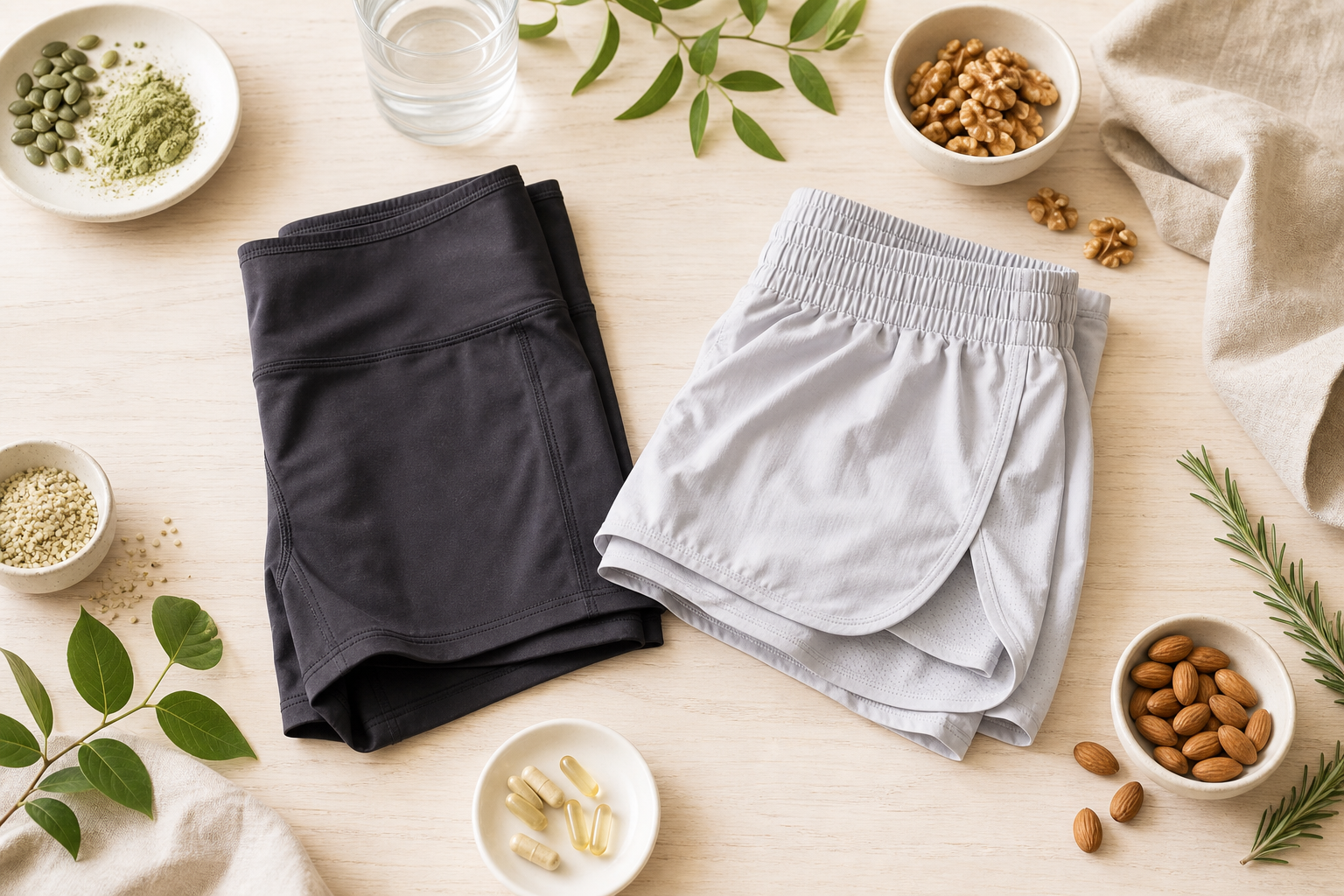
Which inseam should you buy?
If you want the shortest answer: inseam length is a comfort and coverage decision, not a performance one. No published trial shows that a 4-inch, 5-inch or 8-inch short makes you faster, more economical or less injury-prone. What the inseam actually changes is chafe risk, coverage, and how much your legs can move before fabric interferes. This is a spec-based comparison, not a wear test: nothing below comes from running in these garments — it is reasoning from published construction and geometry.
Direction of the answer: pick length by thigh contact and how much skin coverage you want, then pick construction (liner, waistband, split versus straight hem) second. The number on the tag matters far less than what sits against your skin.
Who each length is for – and who should skip it
Start with the negative case, because it is more useful than the sales pitch.
- 4-inch inseam. For runners who want maximum leg freedom and minimum fabric, and who either do not experience inner-thigh chafe or wear a fitted liner short underneath. Skip it if your thighs touch when you run and you dislike a compression liner – a short outer with no thigh coverage is the classic chafe setup.
- 5-inch inseam. The middle ground: more thigh coverage than a 4-inch, still above most of the quadriceps. Skip it only if you specifically want either a track-style minimal cut or full mid-thigh coverage.
- 8-inch inseam. For runners who want the short to sit at or below mid-thigh, either for coverage preference or to reduce direct skin-on-skin contact. Skip it if you run in heat and the extra fabric traps warmth you would rather lose, or if you want an unrestricted stride at speed.
What the inseam number actually measures
Inseam is the length of the inside seam from crotch to hem, measured in inches. It is not the same as the outseam (hip to hem), and two shorts with the same inseam can sit very differently depending on rise. A high-rise 5-inch short covers more thigh than a low-rise 5-inch short, because the crotch seam starts higher relative to your body.
Where possible, judge a short by the pair of numbers – inseam and rise – not the inseam alone. Most brands publish inseam; fewer publish rise as a measured value. Where a rise number is not stated, treat coverage as unknown rather than assuming it from the inseam.
Not to be confused with: "5-inch" as a marketing name versus a measured length. Some ranges round aggressively, and a nominal 5-inch can measure 4.5 in on a small size and 5.5 in on a large, because inseam often scales with size. If exact coverage matters to you, the measured value on your size is the number that counts, not the range name.
Marketing category versus what you can measure
"Compression", "loose fit", "2-in-1", "split short" and "training short" are useful shorthand but they are not defined the way inseam is. Classify a short by measurable construction instead:
- Liner type: none, brief liner, or full compression liner. This drives chafe protection more than the outer length does.
- Hem cut: straight hem versus split (side-vented) hem. A split hem opens more room for a long stride at a given inseam.
- Fabric stretch: woven with limited give versus knit or four-way stretch. Two 5-inch shorts feel completely different if one is a stiff woven and the other a stretch knit.
- Waistband: flat elastic, drawcord, wide compressive band. This is where most "it kept sliding down" complaints originate, independent of length.
A short marketed on its inseam alone tells you almost nothing about how it will run. The construction list above tells you more.
What the length does and does not change
Here the honest split matters. Some effects of inseam are mechanical and easy to reason about; others are marketing claims that do not survive contact with the evidence.
Chafe (mechanically plausible, individual): a longer inseam or a compression liner keeps two skin surfaces from rubbing. If your thighs make contact when you run, thigh coverage is the single most decision-relevant property, and it is why many runners choose an 8-inch outer or a fitted liner regardless of the outer length. This is geometry, not a tested outcome – whether it helps you depends on your build.
Thermal comfort (mechanically plausible): more fabric over the thigh traps more heat. In hot conditions a shorter, more open cut sheds heat better; in cool conditions the difference is trivial. Again, this is reasoning from construction, not a controlled comparison of running shorts.
Performance (untested): there is no direct human outcome evidence that inseam length changes running economy, pace or endurance. Running economy – how much energy you use at a given pace – is driven by biomechanical, neuromuscular and physiological factors. A systematic review of elite Kenyan distance runners describes economy as a multi-factorial measure reflecting biomechanics, neuromuscular function, metabolism and cardio-respiratory factors; none of the contributors it identifies is a garment. That review is thin evidence in its own right — its authors flag a low level of evidence, few included studies and small samples — and it was never designed to test clothing. It is cited here only to show what the field does look at, not as proof that inseam is irrelevant. The honest position is that nobody has measured it. Treat any claim that a shorter or longer short "improves performance" as marketing until a study measures it.
Restriction at speed (mechanically plausible): a long, stiff, straight-hemmed short can limit hip flexion at the top of the stride. A split hem or a stretch fabric removes most of that at any inseam. The relevant variable is hem cut and fabric, not the inch count by itself.
Flaws to expect, whichever length you pick
The winner in your wardrobe will still have a compromise:
- 4-inch: least thigh coverage, so it leans hardest on a liner for chafe control. Ride-up is more noticeable when there is little inseam to grip the leg.
- 5-inch: the fewest sharp trade-offs, which is also why it is the least distinctive – it does most things adequately and nothing at the extreme.
- 8-inch: warmest, most fabric to manage, and more prone to the hem riding up mid-thigh unless the leg opening is fitted. What a manufacturer should fix here is the leg opening: a loose 8-inch hem defeats the coverage the length was chosen for.
How to rank the criteria by evidence
Ranked by how well the evidence supports each, strongest first:
- Chafe protection (thigh coverage or liner) – mechanically plausible, decision-critical. No trial, but the geometry is straightforward and this is the property most people actually feel.
- Waistband hold and rise – mechanically plausible. Determines whether the short stays put; unrelated to the inseam number.
- Hem cut and fabric stretch – mechanically plausible. Governs stride freedom more than inseam does.
- Thermal comfort – mechanically plausible. More fabric, more heat; matters most in the heat.
- Performance benefit – untested. No direct human evidence that inseam changes race outcomes. Do not pay a premium for it.
If your main problem is inner-thigh rub, a fitted liner solves it independently of the outer length; the selection rule is "fitted liner with a flat, non-rolling waistband", not any single product.
What those trade-offs look like on one brand’s range
Specifications, not an endorsement. Sprints publishes all three lengths for women, and the pattern across its spec sheets is the useful part. The 4-inch Avigate Mercy short is 92% polyester and 8% spandex, high-waisted, with a full brief liner and a single zip pocket, listed at $54. The 5-inch and 8-inch Flexion compression shorts are both 75% polyester and 25% spandex — roughly three times the stretch content — both list at $64, both carry four pockets (two phone-depth thigh pockets and two at the back) and both use a silicone hem against ride-up; neither states a brief liner.
Read the pattern rather than the brand: the shortest cut carries the liner and gives up the storage, the longer cuts carry the storage and leave the liner to you. Fabric, liner and pockets move together with length far more often than a spec sheet admits — which is why comparing two shorts on inseam alone tells you so little. The middle of that range is the women’s 5-inch compression short. Fabric, price and stock were read from the brand’s product pages on 15 September 2026 and change often.
Verdict
There is no best inseam, and any guide claiming one is selling a preference as a fact. For most runners the 5-inch is the sensible default because it makes the fewest sharp compromises. Choose a 4-inch if you want minimal fabric and either have no chafe issue or wear a liner; choose an 8-inch if coverage or skin-on-skin contact is your priority and you can accept a little more warmth.
The rule that carries to the next pair you look at: buy the liner and waistband first, the hem cut and fabric second, and treat the inseam number as a coverage preference – never as a performance feature. If a short is sold to you on its inseam alone, you have not been told the things that decide how it runs.
Sources
- Biomechanical factors associated with running economy and performance of elite Kenyan distance runners: A systematic review (J Bodyw Mov Ther, 2018) – used to establish that running economy is a multi-factorial measure driven by biomechanical, neuromuscular, metabolic and cardio-respiratory factors, none of which is garment length.