Does "fits true to size" tell you your size?
No. "Fits true to size" tells you that the garment roughly matches the seller's own size chart – it does not tell you which number on that chart is yours. Two brands can both claim to fit true to size and still put you in a different size, because there is no shared standard behind the words. Before you buy women's running shorts online, the phrase to trust is not a slogan but the measured size chart, and even that has to be read against your own body measurements and against how a particular short is meant to sit.
This guide is a spec-based assessment, not a wear test. No pair described here was run in. The point is to give you a way to read a listing so you can judge the next pair yourself, including one this guide never saw.
Who should be most careful buying shorts online?
Fit prediction from a chart is hardest for the bodies that sit furthest from the fit model a brand designed around. Look elsewhere, or expect to order two sizes, if you fall into any of these:
- A large difference between your waist and hip measurement. Most size charts assume a fixed waist-to-hip ratio. If yours is unusual in either direction, a size that fits your waist will bind or gape at the hip, or the reverse.
- Muscular or larger thighs relative to your waist. This is common in runners and is the single most frequent reason a short that fits the waist rides up or chafes the inner thigh. The waist number on the chart does not predict thigh circumference.
- Height at the edges of the range. Inseam and rise are usually drawn for an average height. Very short or very tall runners get a different length and rise than the label implies.
- Between sizes on the chart. The chart tells you a band, not a point. If you land on a boundary, the words "true to size" resolve nothing.
What number should you compare – advertised or measured?
The useful comparison is between your own body measurement and the garment's flat measurement, not between you and the marketing word. Two numbers matter and are worth finding before you buy:
- Waist (or low waist) circumference of your body, measured with a soft tape, against the chart's stated body waist for each size. This is the number the size chart is actually built on.
- Flat garment waist and hip, if the listing gives it – the width of the garment laid flat, doubled. Divide the doubled figure by your body circumference to see how much room, or compression, the short is designed to have.
If a listing gives only "true to size" and no chart, treat it as not measured. You are being asked to guess. A listing that publishes body-measurement ranges per size, and ideally flat garment dimensions, is giving you something to check; a listing that publishes an adjective is not.
Compression, fitted, or relaxed – which category are you actually buying?
"Compression", "fitted", "regular" and "relaxed" are sold as if they were sizes. They are not. They describe how much smaller than your body the garment is cut, and that changes which size you should order.
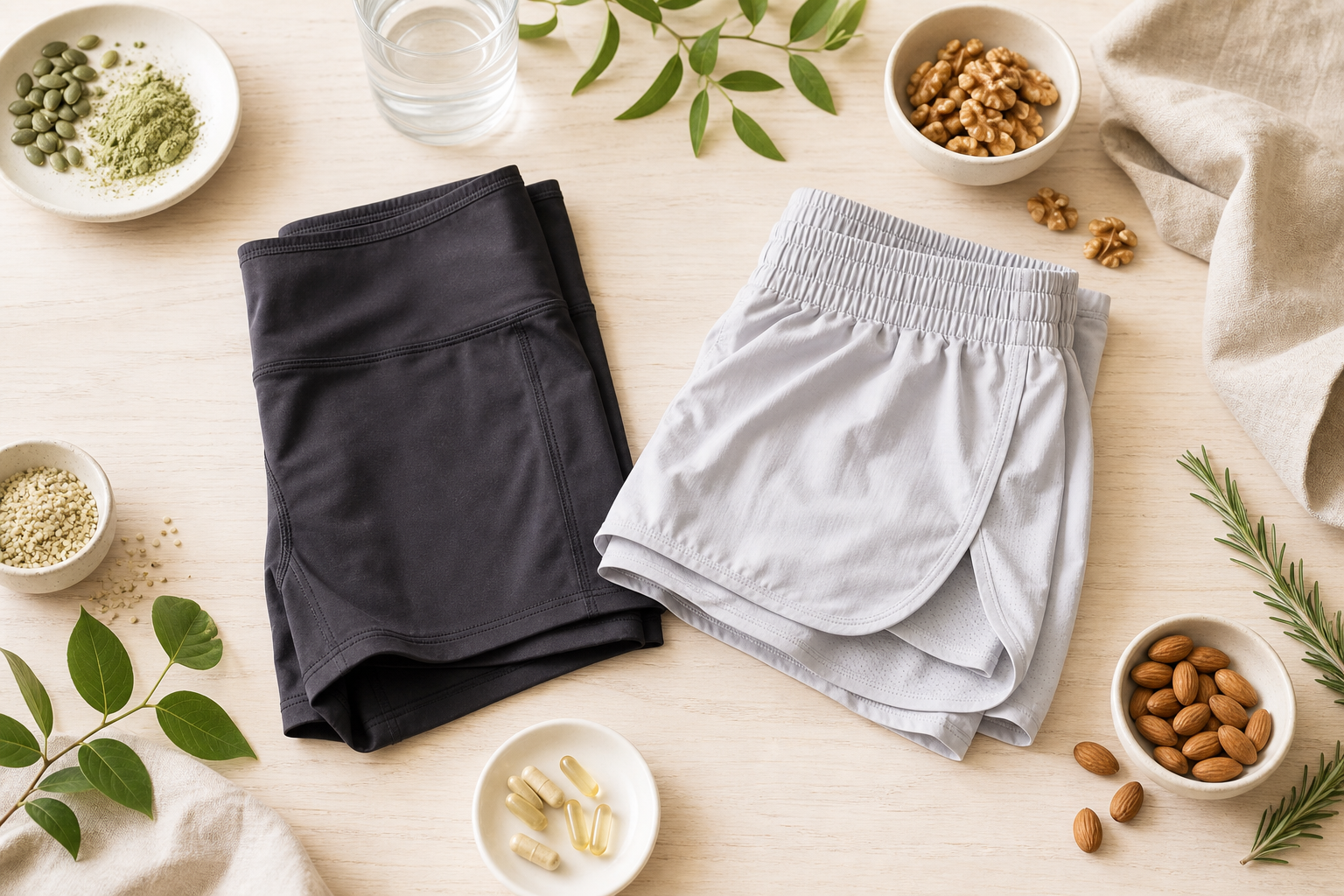
Cut How it relates to your body Sizing consequence Evidence strength Compression / 8-inch tight Cut smaller than your circumference; stretch fabric holds against the leg Runs "small" against a woven chart because it is meant to; size to your body, not down for a snugger feel Construction-based (measurable from flat dimensions and fabric stretch) Fitted short Close to body circumference with light ease Chart size usually holds; thigh circumference is the failure point Construction-based Relaxed / running short with liner Cut with ease at the outer short; liner does the holding Outer size can run generous; liner fit is the real fit question Construction-basedThe practical reading: a longer compression short such as a women's 8-inch compression short is designed to sit close to the leg, so a chart may look as though it "runs small" when it is simply doing its job. If you want that hold, order to your measured size rather than sizing down for extra tightness, and check the flat thigh dimension if it is published. If you want a relaxed short instead, the outer dimensions matter far less than whether the inner liner suits your thighs.
What do the on-page signals actually predict?
Reviews and star ratings are the main evidence a shopper gets, and they are worth reading with their limits in mind.
- A stated "true to size" majority in reviews is more informative than the brand saying it, but it is still an aggregate. It tells you the chart works for the average reviewer's body, not for yours. Read the reviews that mention a body shape like yours and ignore the overall percentage.
- Photographs on varied bodies predict fit better than a single model on a single frame – but only when the listing states the model's height and the size worn. Without those two facts, the photo is decoration.
- Fabric content and stretch direction predict how forgiving a size boundary is. Four-way stretch tolerates a body that sits between sizes far better than a woven or a one-way stretch. This is a construction fact, readable from the listing, not a claim that needs testing.
- Free returns are the honest answer to residual uncertainty. When the chart leaves you on a boundary and the reviews are thin, the rational move is to order two sizes and return one, and a retailer's return policy is a real input to the decision, not a footnote.
Where the common advice is weaker than it sounds
Some sizing rules of thumb are repeated as if settled. Treat them as weakly grounded:
- "Size up for running shorts." This only holds for cuts with ease. For a compression short it produces a short that slides, which is the failure it was meant to prevent. The rule is cut-specific, not universal.
- "Your dress size is your shorts size." Vanity sizing and brand-specific charts break this routinely. The body measurement is the transferable number; the size label is not.
- "Same brand, same size across styles." A brand can hold one chart and still cut a compression tight and a lined short to different amounts of ease. Check the style, not just the label.
Verdict: what to do with the listing in front of you
"Fits true to size" is worth roughly what any unmeasured adjective is worth – it narrows nothing on its own. Rank what you rely on by how well it predicts your fit:
- Your body measurement against the chart's body range – the strongest signal, because the chart is built on it.
- Flat garment dimensions and fabric stretch – strong and readable from the listing, especially for judging compression versus ease.
- Reviews from bodies shaped like yours – moderate; useful only when you filter to your shape.
- Aggregate "true to size" ratings and model photos – weak unless the model's height and size are stated.
- The brand's own "true to size" claim – lowest; it confirms the chart, not your size.
The rule that survives to the next listing: buy to your measured body number, decide compression versus ease from the cut rather than the size label, and keep free returns as your correction for whatever the chart cannot resolve. If a longer tight is what you are after, a women's compression short like women's 8-inch compression short is a reasonable place to apply that rule – size to your body, check the thigh, and let the return policy carry the uncertainty the chart leaves behind.