The word "collagen" on a supplement label tells you almost nothing. There are at least 28 collagen types in human tissue, and the three you actually see marketed — I, II, and III — behave like different molecules with different jobs. Selling them as interchangeable "beauty and joint" powder is marketing, not biochemistry. So before you spend money, it's worth knowing what each type is structurally, where your body actually uses it, and how thin the human evidence really is once you strip away the in-vitro hand-waving.
What the Roman numerals actually mean
Collagen types are classified by their amino-acid sequence and how the triple-helix chains assemble. This isn't trivia — the structure dictates the tissue.
Type I is the workhorse. It's the most abundant protein in the body, forming the dense, load-bearing fibrils of skin dermis, tendon, ligament, and the organic matrix of bone. When people talk about "skin" or "bone" collagen, they mean Type I.
Type II is the odd one out. It's concentrated almost exclusively in hyaline cartilage — the smooth tissue capping your joint surfaces. It forms a looser meshwork that traps proteoglycans and water, giving cartilage its compressive springiness. This is the type behind "joint" collagen products, and it's usually sold in a fundamentally different form (see below).
Type III co-assembles with Type I in the same fibrils, especially in skin, blood vessels, and early wound-healing tissue. It forms thinner, more elastic reticular fibres. You rarely find it sold alone — it rides along with Type I in bovine and porcine hydrolysates.
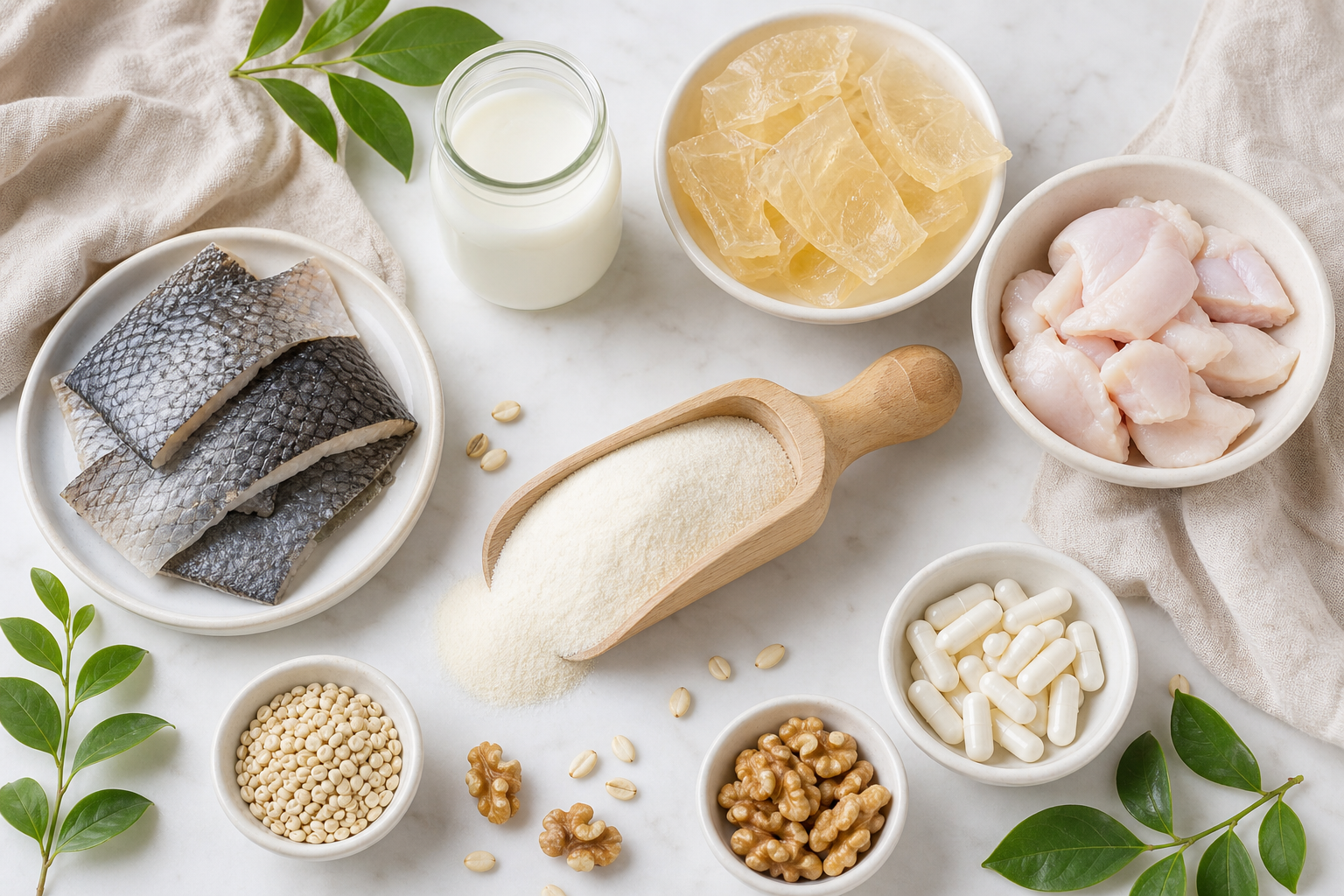
The practical takeaway: the source animal and tissue determine the type. Bovine hide and porcine skin give you I and III. Chicken sternum and cartilage give you II. Marine (fish skin) gives you predominantly Type I.
Hydrolysed peptides vs. undenatured Type II — not the same product
Here's a distinction the industry blurs constantly. Type I/III products are almost always hydrolysed — the protein is enzymatically chopped into short peptides (typically 2,000–5,000 Da) so it dissolves and survives digestion as di- and tri-peptides. The logic is that specific peptides like prolyl-hydroxyproline reach circulation intact and may act as signalling fragments that nudge fibroblasts. That's a mechanistic hypothesis, not a settled clinical fact — the peptide gets absorbed, but "absorbed" and "rebuilds your skin" are separated by a large evidentiary gap.
Undenatured Type II (often labelled UC-II) is the opposite strategy: the collagen is kept in its native triple-helix conformation at a tiny dose, on the theory that presenting the intact epitope to gut-associated lymphoid tissue induces oral tolerance and dampens the immune attack on joint cartilage. Two completely different mechanisms, two different dose ranges (grams for hydrolysates, milligrams for UC-II). If a product mixes "Type II" into a multi-gram hydrolysed scoop, that Type II is denatured and the oral-tolerance rationale no longer applies. Read the form, not just the type.
Bone, Type I, and the collagen-turnover story
Bone is roughly a third collagen by weight — almost entirely Type I — mineralised with hydroxyapatite. This is why Type I collagen keeps getting pitched for bone health, and it's where the mechanism is genuinely interesting even if the supplement evidence is weaker than the marketing.
The connection is real at the level of bone biology. The peptide PINP (procollagen type I N-terminal propeptide) is cleaved off when new Type I collagen is laid down, which is why it's used clinically as a marker of bone formation — research in Bone validated PINP for monitoring patients on the bone-building drug teriparatide, tracking the rise in collagen synthesis. That tells you Type I collagen turnover is central to how bone is built and remodelled. It does not tell you that swallowing collagen peptides builds bone — the biomarker study was about a pharmaceutical anabolic agent, not a supplement.
When you look at what actually moves fracture risk, the heavy lifting is done by drugs, not protein powder. The nutrient side of bone health has its own evidence problem, which I cover in vitamin D3 with K2. A network meta-analysis in Maturitas comparing bone anabolic therapies in postmenopausal osteoporosis ranked prescription agents by efficacy — collagen supplementation is not one of the interventions carrying that evidence. And a meta-regression in the Journal of Bone and Mineral Research found that changes in bone-turnover markers with anti-resorptive drugs tracked with fracture-risk reduction, again reinforcing that the validated levers here are pharmacological. If your goal is treating osteoporosis, collagen is an adjunct at best, and the human supplement data don't support treating it as therapy.
How to choose by type — and what to ignore
Match the type to the goal, then be honest about the evidence strength.
- Skin and connective tissue: look for hydrolysed Type I (and III), from marine or bovine sources. The mechanism — bioactive di-peptides reaching circulation — is plausible; the clinical outcomes are mostly short trials, so keep expectations modest.
- Joint cartilage: decide between hydrolysed Type II (gram doses) and undenatured Type II (milligram doses). These are not the same product and shouldn't be compared on price per gram.
- Bone: Type I is biologically relevant, but don't buy collagen expecting drug-level bone effects. Protein intake and resistance loading matter more than the collagen label.
Selection criteria that actually matter, regardless of brand: choose a product that discloses the collagen type and whether it's hydrolysed or undenatured; prefer third-party batch testing for heavy metals (marine and bovine raw materials can carry them); and check that the effective dose per serving matches the mechanism — grams for hydrolysates, not a fairy-dusted milligram sprinkle. Ignore "multi-collagen 5 types" claims that don't state the amount of each type; a blend that's mostly Type I with a token pinch of everything else is a Type I product wearing a costume.
Vitamin C deserves a mention because it's a genuine cofactor: prolyl and lysyl hydroxylase, the enzymes that stabilise the collagen triple helix, require ascorbate. That's basic biochemistry, not a supplement claim — it's why scurvy is a collagen disease. Adequate vitamin C status is a prerequisite for your own collagen synthesis whether or not you supplement the protein.
The honest summary
Type I is skin, tendon, and bone matrix; Type III rides with it; Type II is cartilage and is often sold as an entirely different (undenatured) product with a different mechanism and dose. The type on the label is really a proxy for the source tissue and the processing. Where collagen biology is best established — bone turnover — the interventions with hard fracture-outcome evidence are pharmaceutical, and the biomarker and drug literature makes that clear. Buy collagen for what the human evidence plausibly supports, match the form to the mechanism, and treat any product promising to "rebuild" tissue as a hypothesis, not a guarantee.
Sources
- PINP as an aid for monitoring patients treated with teriparatide (Bone, 2011)
- Comparative efficacy of bone anabolic therapies in women with postmenopausal osteoporosis: A systematic review and network meta-analysis of randomized controlled trials (Maturitas, 2019)
- Treatment-Related Changes in Bone Turnover and Fracture Risk Reduction in Clinical Trials of Anti-Resorptive Drugs: A Meta-Regression (J Bone Miner Res, 2018)